One controller. Every device. Autonomous.
SparkEdge connects, controls, and optimizes your entire energy site — then syncs to SparkGrid for fleet intelligence.
AI without local execution is just advice. SparkEdge acts.
Lower energy costs
AI-driven self-consumption and peak shaving cut bills automatically.
Solar self-consumption
Store and shift excess solar instead of exporting at low feed-in rates.
Real-time execution
Local AI reacts in milliseconds — no cloud roundtrip, no latency risk.
Offline-first operation
Keep controlling when the internet drops. SparkEdge never stops.
Every device unified
One controller for solar, batteries, EV chargers, heat pumps, and meters.
Intelligence that pays for itself
SparkEdge doesn't just monitor — it actively reduces costs. On-site AI predicts consumption, tracks real-time tariffs, optimizes battery dispatch, and maximizes solar value. Every decision is executed locally with sub-second precision.
Self-consumption optimization
Up to €600/yrStore excess solar in batteries and shift it to evening peaks instead of exporting at low feed-in rates.
Peak demand shaving
Up to €270/yrAI watches site demand in real time and discharges batteries before peaks trigger expensive demand charges.
Tariff-aware scheduling
Up to €200/yrCharge batteries and EVs during cheap grid windows, discharge during high-tariff periods. Automatic, every day.
Predictive management
ContinuousMachine learning forecasts load and generation, so the system pre-positions assets before events happen — not after.
Savings vary by site configuration, tariff structure, and local energy prices. Figures shown are representative for a typical home system with solar + battery in Central Europe.
One OS. Two controller formats. Any site.
Choose the form factor that matches the site. The same SparkEdge software stack runs on both.
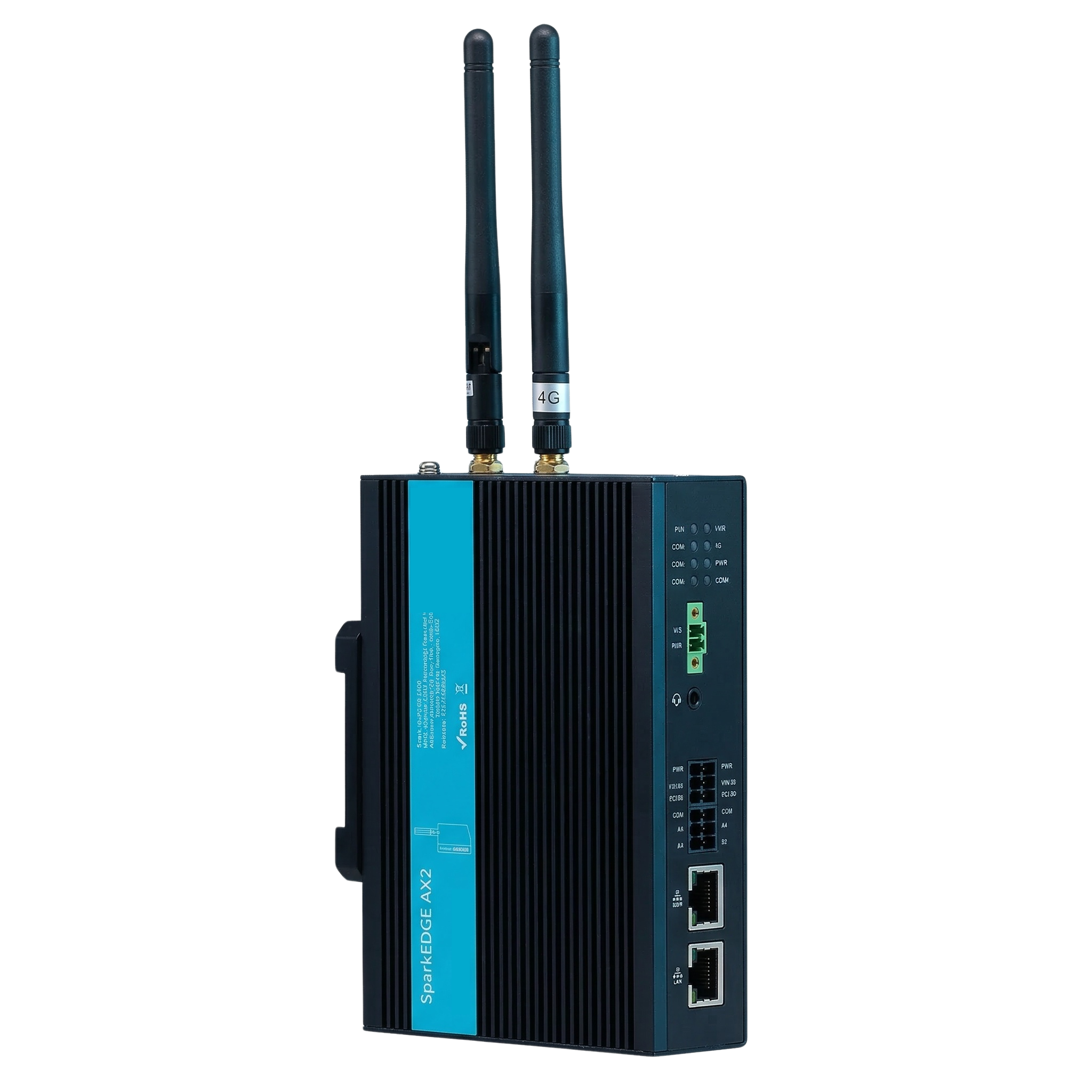
SparkEdge AX
Industrial edge controller
The hardened option for industrial sites, commercial buildings, campuses, depots, and utility-adjacent environments. Built for reliability where communications and power uptime matter.
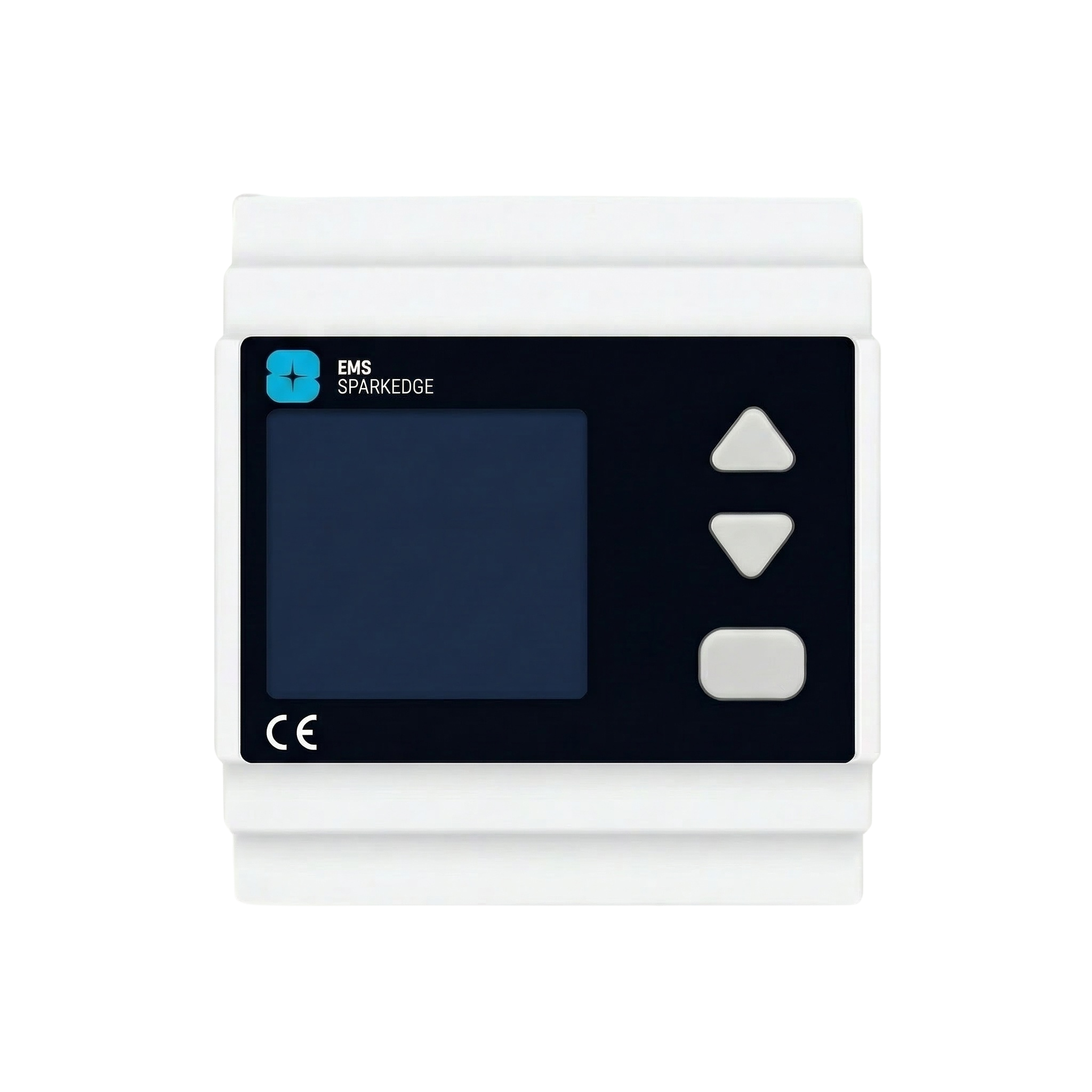
SparkEdge EX
Home & SME energy controller
DIN-rail controller for homes and small-to-medium business sites. Orchestrates solar, battery, heat pump, and EV charging from one compact device with a built-in display.
Cloud visibility is useful. Local execution is essential.
Most energy platforms stop at dashboards. SparkEdge closes the gap between insight and action. It lives on site, next to the devices that matter, so it can keep orchestrating batteries, chargers, HVAC, and loads even during WAN outages. That is what makes modern AI energy management commercially useful: not just better recommendations, but reliable execution where power actually flows.
React in real time
Do not wait for a cloud round-trip to protect a site limit, shift a load, or discharge a battery.
Stay operational offline
If connectivity drops, SparkEdge keeps monitoring, controlling, and storing data locally.
Protect the physical system
Safety, limits, and fallback logic stay on site where they belong.
Unify fragmented equipment
Mixed brands, mixed generations, and mixed protocols become one controllable system.
More than a gateway. SparkEdge is the operating layer of the site.
SparkEdge connects field devices, maps them into a standard energy model, stores and analyzes metrics locally, and runs rules plus autonomous energy applications at the edge. SparkGrid above it adds fleet visibility, portfolio coordination, remote workflows, and enterprise-level intelligence.
The result is simple: one local controller between the messy reality of field devices and the higher-order logic of your EMS platform.
Connect the real world
Energy sites are never single-vendor. SparkEdge is built for heterogeneous environments, from solar inverters and battery systems to meters, heat pumps, EV chargers, water meters, and generic industrial devices. It gives you one local integration layer instead of a new project for every asset class.
SparkEdge uses a protocol-agnostic device abstraction layer, so applications work with standardized metrics instead of vendor-specific register chaos. That means faster integrations, simpler maintenance, and one software stack across very different sites.
Optimize locally. Execute safely.
SparkEdge is the local execution layer for AI-driven energy management. On site, it already runs autonomous energy logic through rules, proposal arbitration, and battery dispatch modes. With SparkGrid above it, higher-level optimization can become action without losing local safety, local resilience, or operator trust.
Economic logic can compete. Physical safety always wins.
Self-consumption optimization
Store excess solar locally and use it when it matters most.
Peak demand shaving
Watch site import in real time and discharge batteries when peaks threaten demand charges.
Tariff-aware dispatch
Shift charging and discharging around time-of-use pricing.
Export limiting
Absorb excess generation before export limits or curtailment become a problem.
Schedules and operator control
Use templates, calendars, manual override, or custom rules when the site requires it.
SparkEdge evaluates time, metrics, and sustained states, turns them into proposals, and arbitrates those proposals by priority. That lets multiple strategies run together without losing control of the physical site.
Built for serious battery operations, not just battery visibility
Battery revenue means nothing if safety can be bypassed. SparkEdge manages battery dispatch across self-consumption, peak shaving, schedule-based control, price arbitrage, and manual operation, while enforcing a compiled safety layer underneath every decision.
This is what makes SparkEdge credible for BESS sites and fleets. Optimization is allowed to be ambitious. Safety is not allowed to be optional. The safety layer is implemented below the strategy layer, so economic logic cannot override physical protection.
Self-consumption · Peak shaving · Arbitrage · Schedules
carlogavazzi.em340.v1
6 register groups·PerPhaseBasic, SystemPQS, Energies, SerialNumber, +2 more
chint.dtsu666.v1
7 register groups·DeviceSetup, Voltages, Currents, ActivePower, +3 more
deye.hybrid.v1
4 register groups·Solar, Power, Battery, EnergyTotals
sungrow.ems300cp.v1
10 register groups·Serial, Grid, Inverter, Battery, +4 more
wavenetic.evcharger.v1
3 register groups·Status, Metering, Control_Writeable
Turn device datasheets into a live operating model
SparkEdge uses JSON-based device models with register maps, data types, scaling factors, lookup tables, and energy role mappings. Import models from the library, validate them in the web UI, or create custom models for new devices. Capability detection then helps SparkEdge understand what each asset can measure or control.
Model once
Define the device clearly instead of hardcoding logic into every application.
Validate before deployment
Check addresses, intervals, data types, and naming before the model goes live.
Reuse everywhere
Once modeled, the device becomes available to dashboards, rules, analytics, and control logic through the same abstraction layer.
See the site the way the controller sees it
SparkEdge is not only a controller. It is also the local operational intelligence layer of the site. Operators can view live energy flows, track KPIs, explore history, inspect device health, analyze communication quality, and go all the way down to live register access when troubleshooting or commissioning.
Live energy flow
See solar, grid, battery, and loads in one real-time power map.
Performance KPIs
Track self-consumption, self-sufficiency, battery efficiency, and site performance over time.
Data explorer
Query local time-series history and export data for reporting or external analysis.
Health monitoring
Monitor silence, latency, timeouts, and device-level health events.
On-demand register access
Read or write live values for commissioning, diagnostics, and maintenance.
For installers, operators, and enterprise teams, this is a major advantage: commission faster, troubleshoot locally, and prove energy performance with actual site data instead of fragmented vendor portals.
Local autonomy on site. Fleet intelligence when you need it.
SparkEdge keeps sites running locally, but it is not isolated. It publishes telemetry reliably, queues data during outages, synchronizes when connectivity returns, supports secure remote access without VPN complexity, and receives cloud-driven updates with integrity checks and rollback support.
This is the right architecture for multi-site operations: let the site stay autonomous, and let the platform coordinate fleets, reporting, remote service, and portfolio logic above it.
Reliable telemetry
Publish structured MQTT data to SparkGrid and external systems.
Zero-data-loss mindset
Store messages locally during outages and replay them in order later.
Secure remote access
Open the local UI through a secure tunnel without exposing the site network.
Over-the-air updates
Roll out updates with verification, version tracking, and rollback capability.
From homes to fleets, the software stack stays the same
Home and prosumer
Run solar, battery, EV charging, and heat pump logic as one local energy system. Maximize self-consumption, protect backup behavior, and keep decisions close to the home.
Commercial buildings and shopping centers
Coordinate rooftop solar, batteries, public charging, HVAC, refrigeration, and tenant loads while protecting site import limits and reducing expensive peaks.
BESS sites and fleets
Dispatch locally, enforce safety, protect asset life, and coordinate upward to portfolio strategy through SparkGrid.
EV charging fleets and depots
Balance chargers against solar, batteries, and site constraints with low-latency local control.
OEM and embedded partners
Ship SparkEdge inside your own product or enclosure and bring a production-grade local EMS to market faster.
Industrial-grade where it matters. Simple where it should be.
SparkEdge is designed for real deployment, not demo environments. It runs as a single binary on embedded Linux, with no microservice sprawl and no external runtime dependencies. It can be secured with role-based access control, TLS, secure sessions, CSRF protection, content security policies, rate limiting, and token-based tunnel access.
Simple deployment
Deploy quickly on supported embedded hardware and manage it like a real edge product, not a fragile container stack.
Secure by design
Protect local access, remote sessions, API calls, and tunnel usage with modern security controls.
Operationally reliable
Run as a system service with restart behavior, graceful shutdown, and embedded resilience.
For OT and enterprise buyers, this matters. SparkEdge is easier to deploy, easier to maintain, and easier to trust than a stitched-together edge stack.
Every energy site is becoming an autonomous energy node
The future of energy will not be won by disconnected hardware. It will be won by sites whose devices can think and act together. SparkEdge is built for that shift: local enough to react in real time, open enough to connect messy field infrastructure, and scalable enough to become part of a fleet-wide energy operating system.
Today, SparkEdge already connects, models, controls, stores, and syncs. Over time, that same architecture can support deeper automation, broader site coordination, and more advanced AI-led optimization across homes, buildings, depots, and energy fleets.
Frequently asked questions
Those apps show individual devices. SparkEdge orchestrates the whole site as one system, across mixed assets and mixed vendors.
SparkEdge continues to run locally and stores telemetry on site, then synchronizes when connectivity returns.
The current documented stack includes Modbus RTU, Modbus TCP, MQTT client, a built-in MQTT broker, LoRaWAN, and wireless M-Bus.
Yes. SparkEdge is built to coordinate multiple asset types under shared rules, site limits, and local automation logic.
No. The same software stack can be used from home and prosumer systems up to commercial, fleet, and industrial deployments, with different hardware formats for each scale.
Yes. The OEM module concept is part of the SparkEdge hardware family and is a strong route for white-label or embedded partnerships.
Ready to deploy local AI energy control?
Bring fragmented devices, local automation, and real-world execution into one system with SparkEdge.
For home systems, commercial sites, BESS fleets, EV charging fleets, and OEM partners.